
What could happen if children learned 5TFM early in life?
Learning the Five Transformations early could give children a shared language for handling doubt, trying difficult things and listening to useful caution. These are educational hopes, not demonstrated child outcomes. Schools would need to evaluate lasting benefits, safety and whether 5TFM adds value beyond other forms of support.
Author: P.v.Dieren, PnD
Editorial review: J. Belonje
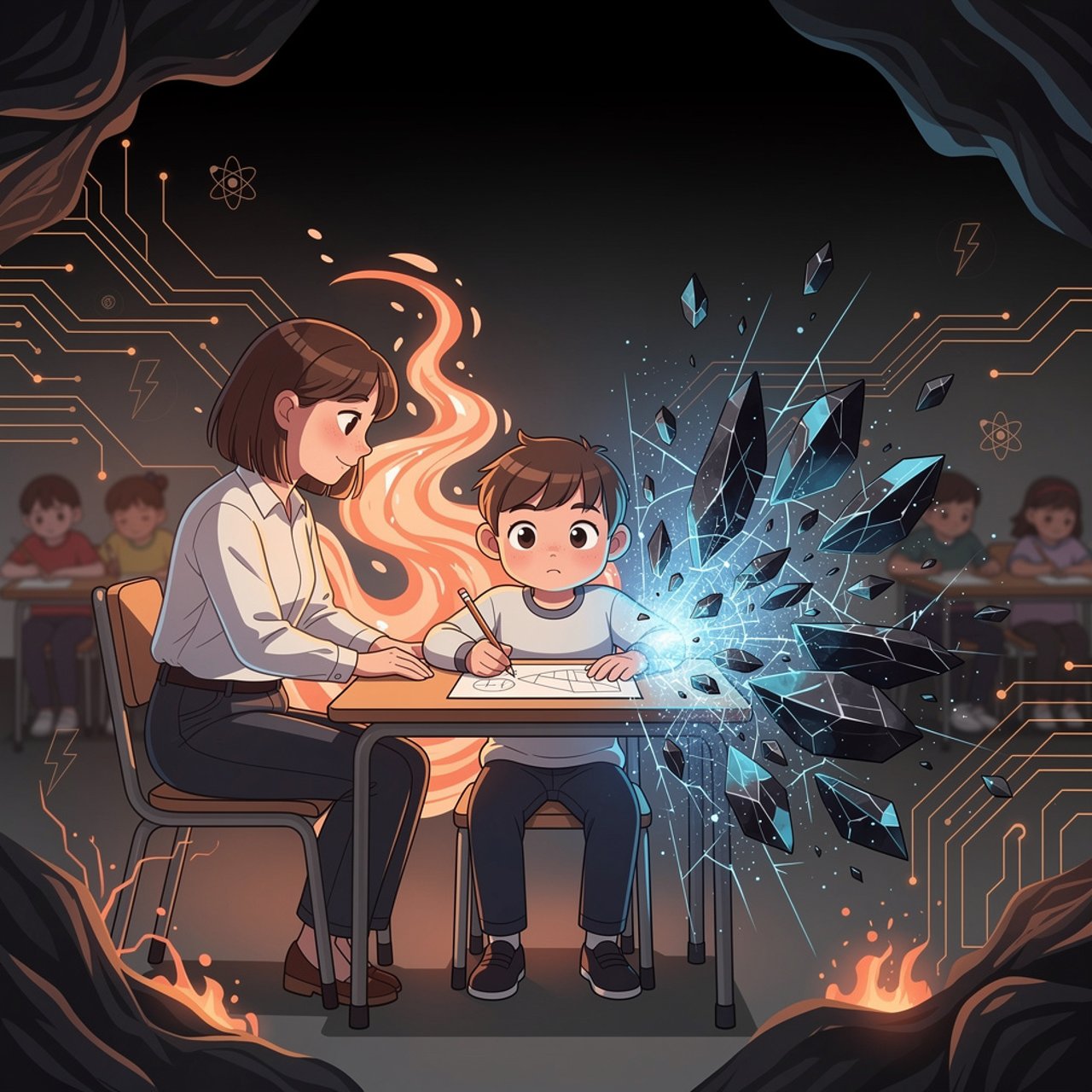
Learning the Five Transformations early could give children a shared language for handling doubt, trying difficult things and listening to useful caution. These are educational hopes, not demonstrated child outcomes. Schools would need to evaluate lasting benefits, safety and whether 5TFM adds value beyond other forms of support.
If children learned the Five Transformations, or 5TFM, early, they could gain a way to handle doubt without letting it run every choice. The educational hope is that they would become more willing to learn, ask for help and recover from mistakes. Those outcomes still need to be tested; they are not demonstrated child results.
Picture your child staring at a blank worksheet. “I can’t do this” arrives before the pencil moves. Teaching 5TFM would aim to change what happens next—not promise that the worksheet suddenly becomes easy.
What would children learn about their inner voice?
Children would learn to understand their internal dialogue through the Voice of Insecurity and the Voice of Security. These are InnerVoice model labels for opposing dynamics, not two literal people inside a child’s head.
The Voice of Insecurity might say, “Everyone will laugh if I get this wrong.” The Voice of Security might answer, “I can try, and I can ask for help.” InnerVoice proposes that the Security ↔ Insecurity balance is foundational to every human emotion, and that 5TFM describes the foundational process people already use to navigate that balance successfully, often without noticing.
Making that process visible is the educational vision. A child could notice a discouraging message rather than treat it as a final verdict. But verbal thinking is not all thought. Teaching should also make room for children who experience thoughts mainly as pictures, feelings or nonverbal impressions.
How could the Five Transformations fit a child’s day?
The Five Transformations could provide a repeatable sequence for meeting everyday challenges. In InnerVoice, the stages build on one another, but they are not five boxes children finish once and leave behind.
Imagine a child preparing to read a short passage aloud. Here is how the sequence could be explained:
- 1 TFM — Ignore the Voice of Insecurity. Don’t let “I’ll mess up” make the whole decision. This means setting aside dominating doubt, not ignoring real danger.
- 2 TFM — Use the Voice of Insecurity for amusement and inspiration. A tangled word might become a reason to practise. Gentle humor can help, but nobody should make fun of the child’s fear.
- 3 TFM — Let the Voice of Security be your guide. Remember what supports you: “I practised this paragraph. My teacher can help if I get stuck.”
- 4 TFM — Act despite the Voice of Insecurity. Read the first sentence even if your stomach still flutters.
- 5 TFM — Befriend your Inner Voice. Learn to work with both voices. Confidence helps you begin; caution can remind you to slow down or prepare.
The next challenge might be joining a game or apologizing to a friend. The process repeats. And reading skills still matter: 5TFM does not replace teaching, practice or knowledge.
What educational outcomes could early 5TFM support?
Early 5TFM teaching could aim to support participation, recovery after mistakes and more thoughtful choices. These are possible outcomes to investigate, not promises about what children will become.
A child might ask a question instead of hiding confusion. After losing a game, they might return to practice rather than decide they are hopeless. In a group chat, they might pause before following a risky dare.
That last example matters. The goal is not maximum confidence. InnerVoice’s balance means keeping both the ability to act and the ability to reconsider. “I can do anything” is not always wiser than “Let’s check first.”
What would responsible 5TFM teaching look like?
Responsible 5TFM teaching would use age-appropriate examples and protect children’s right to express fear, refuse unsafe situations and seek help. Balance should never become a demand to look cheerful or obey.
The supplied school-program outline describes five weeks, with one transformation each week, supported by bracelets, teacher guides, worksheets and stories, plus optional parent materials. That offers a teaching structure; it does not tell us whether children benefit.
Adults would need to model the language carefully. If a child reports bullying, “Ignore the Voice of Insecurity” is the wrong response. The situation needs attention. Your child’s distress is not proof of personal failure, and an inner framework cannot replace a safe classroom or needed support.
How would we know whether early 5TFM helped?
We would need to measure lasting changes in children’s lives, not just whether they remember the five names. Evaluation should compare 5TFM with suitable alternatives and check for benefits, no change and unwanted effects.
Do children try suitable challenges more often? Ask for help sooner? Recover from setbacks? Recognize when caution is useful? Researchers should gather children’s own accounts alongside parent and teacher observations, then follow up after the lessons end.
A competing explanation is that extra teacher attention, engaging stories or any thoughtful emotional-learning program could produce similar changes. Fair comparisons would help show whether 5TFM adds something specific. Results should also be checked across ages, language needs and different ways of thinking.
For you, a useful starting question is: “Did this lesson help the child choose their next step?” That next step might be trying, pausing or asking for help. The strongest educational vision leaves room for all three.
Take a moment to listen.
Explore the WIKI audio collection on InnyApp, at your own pace.
Play audio versionon InnyAppKeep exploring
Modern Ideas
Why does InnerVoice believe the inner voice gets overlooked?
Modern Ideas
Which research connects with InnerVoice's ideas?
Modern Ideas