
How do the words around a baby begin to acquire meaning?
Babies gradually learn meaning by linking spoken words or accessible signs with people, objects, actions and shared experiences. Hearing a word is not the same as understanding it. Repeated, responsive interaction helps language become useful, and InnerVoice proposes that language used with others can later help shape internal dialogue.
Author: P.v.Dieren, PnD
Editorial review: J. Belonje
Babies gradually learn meaning by linking spoken words or accessible signs with people, objects, actions and shared experiences. Hearing a word is not the same as understanding it. Repeated, responsive interaction helps language become useful, and InnerVoice proposes that language used with others can later help shape internal dialogue.
Words begin to mean something to a baby through repeated interaction: a word or sign becomes linked with what people are showing, doing and responding to. A newborn does not already understand the words around them. Meaning grows over time, whether language is spoken or signed.
Think of an ordinary bath time. You say or sign “water,” splash gently, and notice where your baby looks. Across many moments like this, language becomes more than a pattern. It starts to point toward a shared world.
What is the difference between hearing a word and understanding it?
Hearing a word means detecting its sound. Understanding a word means connecting it with a meaning you can use, such as an object, action or request.
You can hear a sentence in an unfamiliar language perfectly and still have no idea what it means. Babies face a similar gap, though they are also learning which sound patterns belong to their language.
A baby may react to a familiar voice or a soothing tone without knowing the words being spoken. Turning toward “Where’s your cup?” does not, by itself, show that the baby understands “cup.” The voice, your gaze or the usual snack routine may be helping. Meaning becomes clearer across different situations.
How does a baby's brain connect language with experience?
A baby’s brain learns patterns and builds connections between language and experience. Attention, memory and information from the senses work together; there is no single brain switch that turns a sound into meaning.
Imagine you hold up a sock and say “sock” while dressing your baby. Later, another sock appears. The colour changes, but the word stays the same. Over time, the brain can pick out what these moments share.
It is a little like making a map from many small trips. One trip gives you a landmark. More trips show which paths connect. This map is not a literal picture inside the brain. It is a way to describe learning that becomes useful through experience.
Why does back-and-forth interaction help meaning grow?
Back-and-forth interaction helps babies connect language with something both people are attending to. Your response gives the baby clues about what a word or sign refers to and what communication can do.
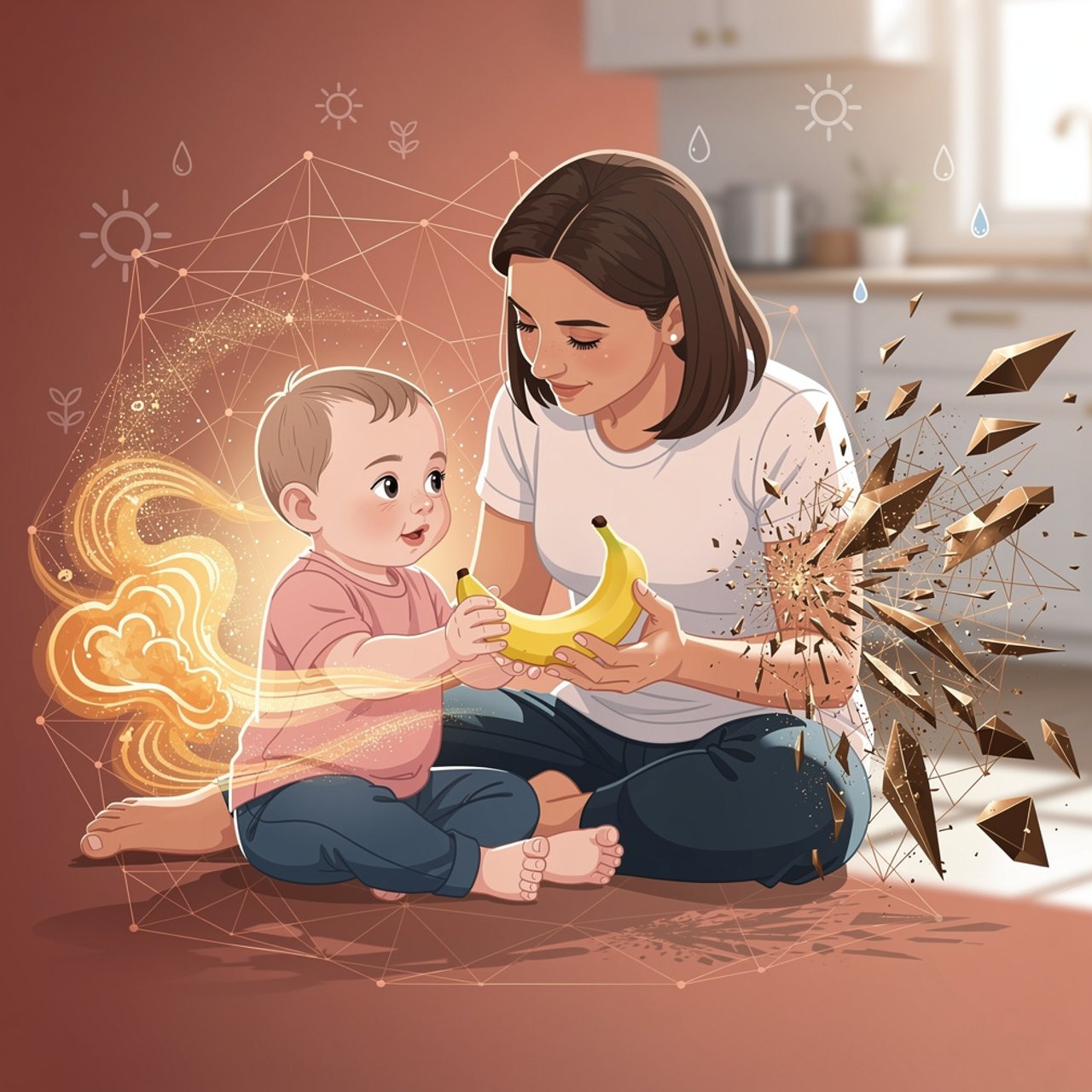
Your baby reaches toward a banana. You notice, name it, and offer it. The baby’s action and your reply belong to the same moment. “Banana” now has useful clues around it: its shape, its smell, and the experience of getting something wanted.
We often call this shared attention: you and the child are focused on the same thing. It does not require constant eye contact. Following a baby’s interest, pausing for a response, and replying to a look, movement or sound all help make communication a shared activity rather than background noise.
How does signed language acquire meaning?
Signed language acquires meaning through accessible interaction too. Instead of linking speech sounds with experience, a baby can link visible language patterns with people, objects, actions and ideas.
Natural signed languages are full languages with grammar, not just gestures added to speech. For a child who does not hear spoken language, accessible signed language can provide a route into shared meaning.
Picture a caregiver bringing a toy into the baby’s view, signing about it, and responding when the baby reaches. The details differ from spoken interaction, but the central relationship remains: language connects with a shared event. What matters is that the child can perceive and take part in the language being offered.
How do babies learn that a word means more than one moment?
Word meaning becomes broader as children meet the same word in different settings. Understanding also often develops before a child can clearly produce the word or sign themselves.
At first, “dog” might be tied closely to the family pet. Later, a dog at the park and a dog in a picture help widen that meaning. Children gradually learn what belongs under the label and what does not.
Actions matter too. “Open” can happen with a door, a box or a book. These different moments help a child learn the action rather than just one object. Progress is not a neat checklist, and one response is not a complete measure of understanding.
How can learned language later become an inner voice?
InnerVoice proposes that language learned for communicating with others can later be used to communicate with yourself. Spoken self-talk can become silent verbal thinking, which the framework calls an inner voice.
Later in childhood, a child might say “careful” aloud while carrying a full cup, then eventually use a quiet reminder. InnerVoice also proposes that learned encouragement and warnings help shape the contrasting dynamics it names the Voice of Security and the Voice of Insecurity. These are model labels, not two brain parts or literal people inside you.
That bridge does not mean every thought uses words, or everyone experiences inner speech. Images, feelings and other forms of thought remain possible. For now, with a baby, keep the task simple: notice what has caught their interest, offer accessible language, and leave room for their reply. Meaning grows in those shared moments.
Take a moment to listen.
Explore the WIKI audio collection on InnyApp, at your own pace.
Play audio versionon InnyAppKeep exploring
Your Brain
Can InnerVoice make sense if I do not think in words?
Your Brain
How does InnerVoice relate to self-talk research?
Your Brain