
What are neurons and synapses, in plain language?
Neurons are nerve cells that receive and send signals. Synapses are the contact points where those signals pass between cells. Together, they form changing networks that support what you notice, learn, feel and do. InnerVoice’s brain-pathway metaphors describe patterns becoming familiar, not separate circuits for each thought or inner voice.
Author: P.v.Dieren, PnD
Editorial review: J. Belonje
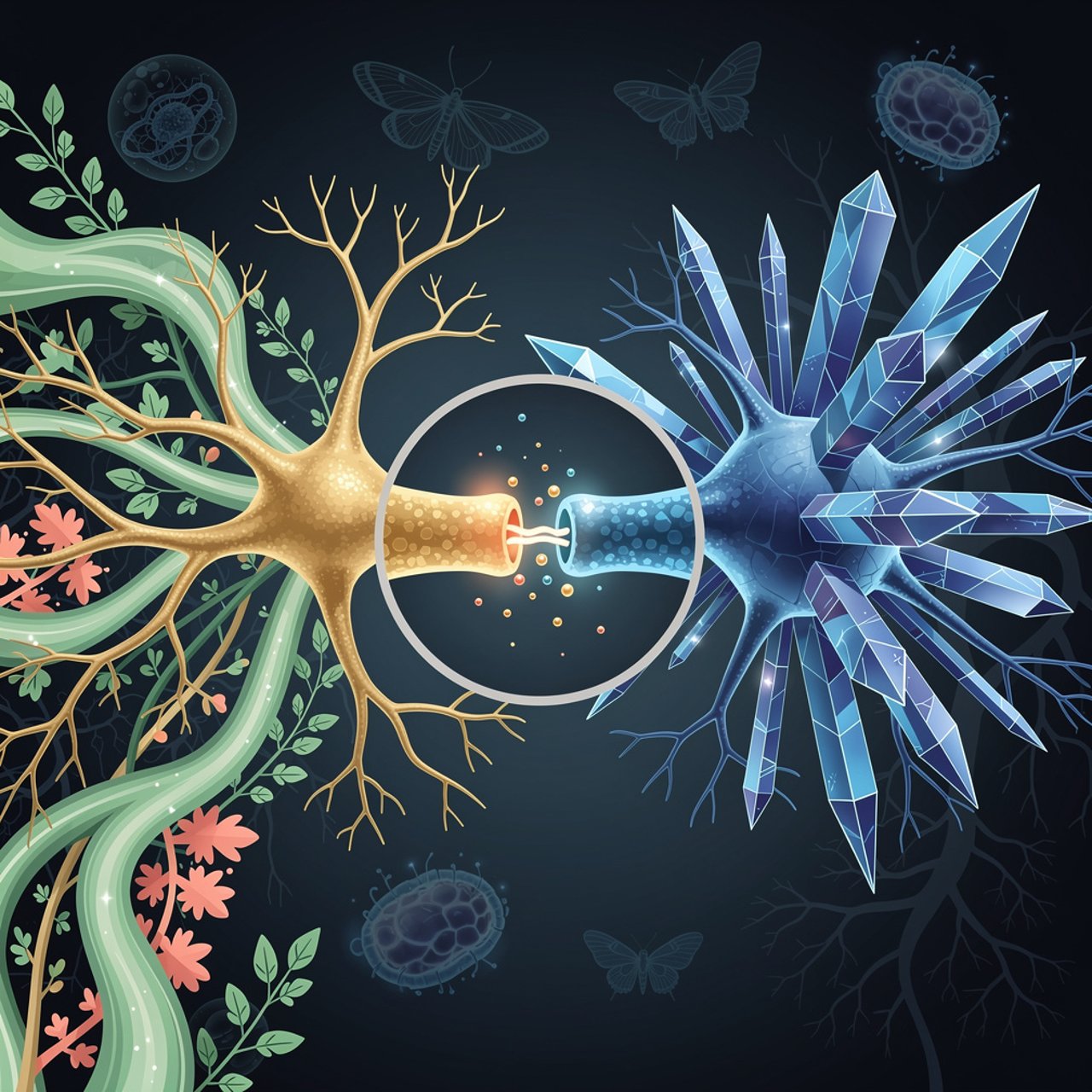
Neurons are nerve cells that receive and send signals. Synapses are the contact points where those signals pass between cells. Together, they form changing networks that support what you notice, learn, feel and do. InnerVoice’s brain-pathway metaphors describe patterns becoming familiar, not separate circuits for each thought or inner voice.
Neurons are nerve cells that receive and send signals. Synapses are the contact points where a neuron passes a signal to another cell. Together, they help your brain turn information into experience and action, whether you are finding your keys, remembering a name or quietly telling yourself, “You can handle this.”
The useful picture is not a tiny person inside your head sending orders. It is a vast, living network. Let's look at how its cells communicate, and what the book's “brain pathways” mean for you.
What does a neuron actually do?
A neuron receives signals, combines their effects and can send signals onward. Neurons work with many other cells; one neuron does not manage a whole feeling or decision.
Most neurons have branching parts called dendrites, which receive many incoming signals. A cell body keeps the neuron functioning. A longer extension, called an axon, carries signals toward other cells.
Picture a tree with many small branches gathering input and a long cable carrying output. That picture helps you remember the parts, though real neurons come in different shapes.
When you reach for your mug, networks help you see its handle, judge its position and move your fingers. Much of this happens without a spoken thought. Neurons support far more than your internal dialogue.
How does a signal travel through a neuron?
Signals within neurons involve electrical changes across the cell's outer membrane. A brief electrical pulse called an action potential can travel along the axon.
This is not electricity flowing through a metal wire. Tiny charged particles move through channels in the cell membrane, creating a change that travels along it. Think of a stadium wave: each nearby section joins in, carrying the wave forward.
Incoming signals can make a neuron more or less likely to produce a pulse. Their combined effect matters. The pulse itself does not contain a complete sentence such as “I forgot the milk.” Meaning depends on patterns of activity across networks, not on one cell sending a miniature text message.
What happens at a synapse?
A synapse is a specialized contact where a neuron influences another cell. At most synapses in your brain, that communication uses chemical messengers called neurotransmitters.
When an electrical pulse reaches the sending end, it can trigger the release of neurotransmitters. These cross a tiny gap and attach to receptors on the receiving cell. Receptors are proteins that respond to particular chemical signals.
Imagine a handoff across a narrow counter. The sending cell releases the messenger; the receiving cell has places that can respond to it. The response can encourage or reduce further signaling, depending on the messenger and receptor involved.
Some synapses instead pass electrical current directly between cells. So “neurons use electrical signals within cells and chemical signals between cells” is a useful starting point, but not the whole story.
Do brain pathways match individual thoughts?
Brain pathways are connected routes through which neural activity can travel. A thought usually involves activity across many cells and networks, not one private pathway assigned to one sentence.
Think about hearing your front door open. You notice a sound, recognize it, recall who is expected home and decide whether to look up. Those functions draw on interacting networks. Some of the same networks also contribute to other experiences.
A road map is helpful here: routes overlap, branch and serve many destinations. But your brain is more flexible than a printed map. Its activity changes with your surroundings, your body and what you have learned. There is no simple “worry road” that carries every worry.
How do neurons and synapses change with learning?
Learning can change how strongly neurons influence one another and how networks work together. This capacity for change is called neuroplasticity.
The first time you use a new phone, you hunt for every button. With practice, your fingers find the right places more easily. Changes in neural connections help support that learning, alongside your attention, feedback and experience.
The book's “superhighway” metaphor points toward patterns becoming easier to repeat. But repeating a negative thought does not automatically strengthen one specific synapse. Learning is more complex than that, and connections can become stronger or weaker. Familiar does not mean permanent.
How do these connections relate to your inner voices?
InnerVoice uses the Voice of Security and Voice of Insecurity as labels for opposing dynamics in your internal dialogue, not separate neurons or brain structures. InnerVoice proposes that the dynamic Security and Insecurity balance is foundational to every human emotion.
Before making a call, you might think, “I'll stumble,” then, “I can prepare.” The framework helps you work with those positions. Caution can prompt preparation; confidence can help you act. Neither needs to silence the other.
Your next step can be that simple: notice a familiar response and try one useful action. Prepare your opening sentence, then make the call. You do not need to picture a particular synapse changing. Neurons and synapses explain how learning is possible; practice gives you something to learn.
Take a moment to listen.
Explore the WIKI audio collection on InnyApp, at your own pace.
Play audio versionon InnyAppKeep exploring
Your Brain
Can InnerVoice make sense if I do not think in words?
Your Brain
How does InnerVoice relate to self-talk research?
Your Brain